
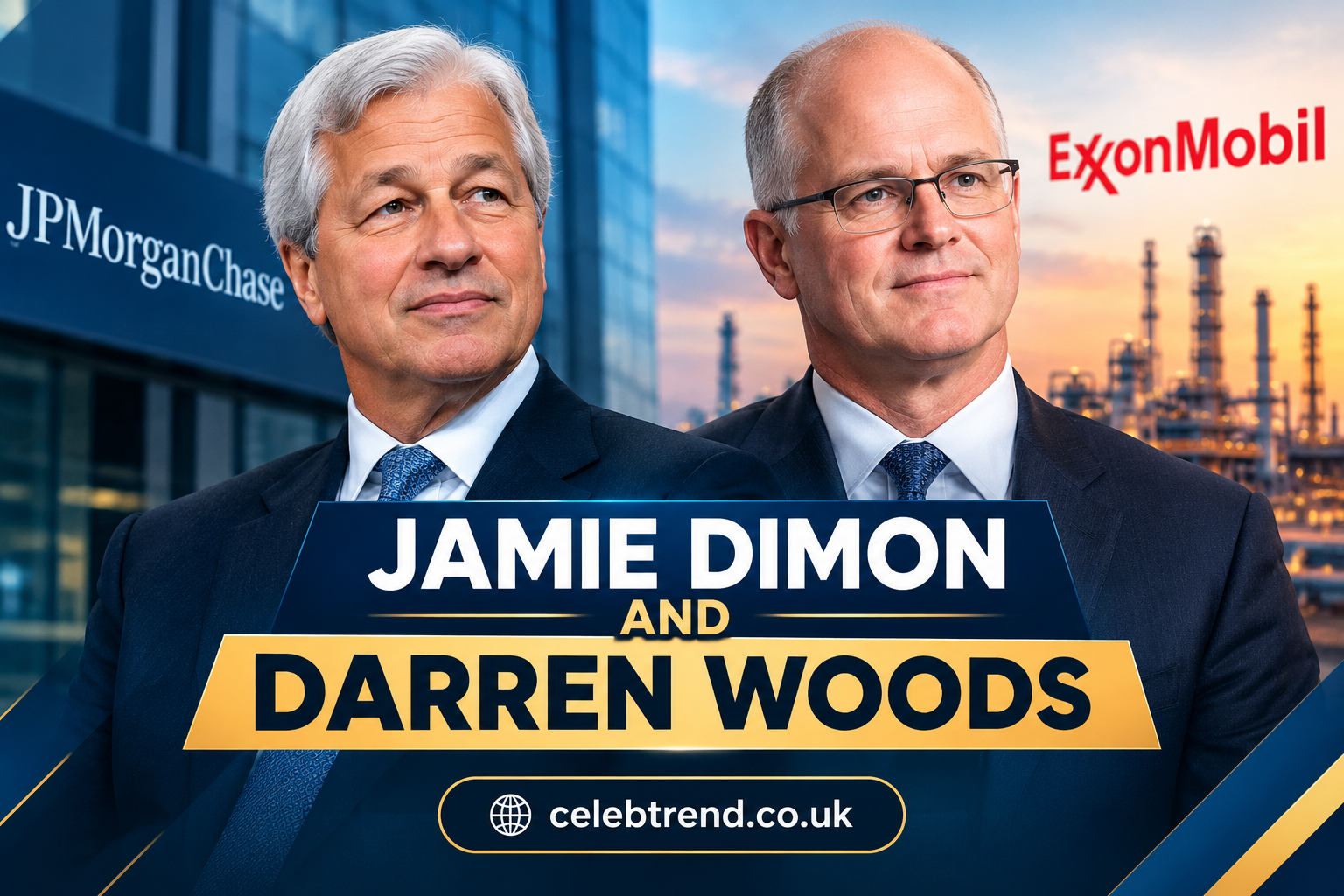
Jamie Dimon and Darren Woods are two prominent names in American corporate leadership, but they operate in very different industries. Jamie Dimon is the Chairman and Chief Executive Officer of JPMorganChase, one of the world’s largest financial institutions, while Darren Woods is the Chairman and Chief Executive Officer of ExxonMobil, one of the world’s largest integrated energy companies. Their careers offer an interesting comparison between financial services and the global energy industry.
Although Jamie Dimon and Darren Woods lead different types of businesses, their responsibilities have several important similarities. Both oversee enormous organizations, make long-term investment decisions, manage complex global operations, and regularly address issues involving economic growth, capital allocation, technology, regulation, and international markets. Their professional paths also show two different ways of reaching the top of corporate America.
Jamie Dimon’s Career and Rise at JPMorganChase
Jamie Dimon has spent much of his professional life in financial services. After graduating from Tufts University, he earned an MBA from Harvard Business School and began his career in the financial industry. His early professional experience included working at American Express and later becoming involved in major corporate transactions and financial organizations.
A major step in Dimon’s career came through Commercial Credit and its subsequent development into a larger financial organization. He later held senior positions at Travelers and Smith Barney and became involved with Citigroup following the Travelers and Citicorp combination. These experiences exposed him to investment banking, consumer finance, corporate management, and financial markets.
Dimon became chairman and CEO of Bank One in 2000. Bank One subsequently merged with JPMorgan Chase, creating one of the most important developments in Dimon’s career. He became president and chief operating officer of the combined organization in 2004 before becoming CEO of JPMorganChase in 2006. He became chairman in 2007.
Under Dimon’s leadership, JPMorganChase has remained a major participant in investment banking, commercial banking, consumer banking, asset management, payments, and other financial services. His long tenure has made him one of the most recognizable banking executives in the United States.
Darren Woods and His ExxonMobil Journey
Darren Woods followed a considerably different professional path. He studied electrical engineering at Texas A&M University before earning an MBA from Northwestern University’s Kellogg School of Management. His combination of engineering and business education became relevant to a career that would eventually span technical, operational, financial, and executive responsibilities.
Woods joined Exxon Company International in 1992 as a planning analyst. Unlike executives who move between numerous corporations before becoming CEO, Woods developed most of his career within ExxonMobil. He progressed through a variety of positions involving planning, operations, refining, supply, transportation, chemicals, and international business.
He became a vice president of ExxonMobil Chemical Company in 2005 and later took on increasingly senior management responsibilities. In 2012, Woods became president of ExxonMobil Refining and Supply Company. He was elected senior vice president in 2014 and became president of ExxonMobil in 2016.
On January 1, 2017, Woods became Chairman and Chief Executive Officer of ExxonMobil. His rise through the company’s ranks gave him extensive knowledge of its operations before taking responsibility for the entire organization.
JPMorganChase and ExxonMobil Represent Different Industries
The biggest difference between Jamie Dimon and Darren Woods is the nature of the businesses they lead. JPMorganChase is fundamentally a financial-services organization, while ExxonMobil is an energy and industrial company.
JPMorganChase provides services that include investment banking, commercial banking, consumer financial services, asset management, and payments. Its business is closely connected to interest rates, credit markets, capital markets, consumer spending, corporate investment, and global economic conditions.
ExxonMobil operates across major areas of the energy industry. Its activities include oil and natural gas production, refining, fuels, chemicals, lubricants, technology, and lower-emission initiatives. Its performance can be affected by commodity prices, global energy demand, production levels, refining margins, geopolitical developments, and energy policies.
Despite these differences, the two companies are connected through the wider economy. Energy companies require financing and investment, while banks serve businesses throughout the energy sector. Changes in energy prices can also influence inflation, transportation, manufacturing, consumer spending, and economic growth.
Jamie Dimon’s Approach to Business and Economic Issues
Jamie Dimon’s public role extends beyond traditional banking. As the leader of one of the world’s largest financial institutions, he regularly discusses economic growth, investment, regulation, trade, technology, national security, and global markets.
A major theme in Dimon’s leadership has been the importance of long-term investment. Large financial institutions need to continuously invest in technology, cybersecurity, employees, infrastructure, risk management, and client services. JPMorganChase also operates across numerous markets, meaning that changes in the global economy can affect many areas of its business.
Dimon has also frequently addressed the relationship between government policy and private-sector investment. Issues such as regulation, trade, industrial policy, infrastructure, and geopolitical developments can influence corporate decisions and financial markets.
His position gives him a broad perspective because JPMorganChase serves individuals, small businesses, corporations, governments, and institutional investors. As a result, his comments often reflect developments across multiple parts of the economy rather than banking alone.
Darren Woods and the Future of the Energy Industry
Darren Woods has faced a different set of challenges as leader of ExxonMobil. The energy industry is influenced by global demand, commodity prices, technological developments, geopolitical events, environmental policies, and changing expectations about future energy systems.
Woods has emphasized the continued importance of oil and natural gas in meeting global energy demand while also supporting investment in technologies designed to reduce emissions. ExxonMobil has pursued areas including carbon capture and storage, hydrogen, and other lower-emission technologies.
The energy transition is particularly complex because energy systems cannot be transformed instantly. Countries have different levels of economic development, infrastructure, energy resources, and electricity requirements. Industrial sectors such as transportation, manufacturing, chemicals, and heavy industry also have different technological needs.
ExxonMobil’s strategy under Woods therefore involves maintaining its traditional energy businesses while investing in technologies that the company believes can address future energy and emissions challenges.
The Connection Between Finance and Energy
The relationship between Jamie Dimon and Darren Woods becomes more understandable when finance and energy are viewed as interconnected parts of the global economy.
Energy companies require significant amounts of capital. Developing oil and gas projects, constructing facilities, maintaining infrastructure, expanding refining capacity, and investing in new technologies can involve substantial financial commitments.
Financial institutions such as JPMorganChase participate in the broader financial system that supports companies and investors. Banks can provide lending, underwriting, advisory services, payments, risk management, and other financial services to businesses across many industries.
Energy markets can also influence financial markets. Changes in oil and gas prices can affect inflation, corporate profits, transportation expenses, consumer spending, and economic growth. Financial institutions therefore monitor energy markets closely.
This creates a natural intersection between the professional worlds of Dimon and Woods even though one leads a bank and the other leads an energy company.
Jamie Dimon and Darren Woods in Corporate Leadership
Both Jamie Dimon and Darren Woods have significant responsibilities involving capital allocation and long-term corporate strategy. However, the decisions they make are shaped by the industries in which their companies operate.
For JPMorganChase, capital allocation can involve technology, financial infrastructure, lending, acquisitions, business expansion, risk management, and investments in strategic capabilities.
For ExxonMobil, capital allocation can involve exploration, production, refining, chemicals, technology, infrastructure, energy projects, and lower-emission businesses.
Both executives must balance short-term performance with long-term objectives. A major corporation cannot focus exclusively on the next quarter because important investments may require years before their full benefits become visible.
Corporate governance is another shared area. Both companies have shareholders, boards of directors, employees, customers, regulators, and other stakeholders whose interests must be considered as part of long-term management.
Their Shared Presence in Major Business Discussions
Jamie Dimon and Darren Woods have also appeared in prominent institutional business discussions. One notable example came through the Council of Institutional Investors’ 2024 fall conference, where Dimon participated as a speaker and Woods took part in a live remote interview.
The event brought together institutional investors and corporate governance participants. Topics surrounding corporate governance, investment, shareholder interests, and long-term business management are relevant to both JPMorganChase and ExxonMobil.
Their participation illustrates how leaders from very different industries can become part of the same corporate and investment conversations.
Institutional investors frequently hold positions in companies across many sectors. Their interests can include financial performance, governance, capital allocation, executive accountability, risk management, and long-term corporate strategy.
For executives such as Dimon and Woods, communication with investors is therefore an important part of leading a major public corporation.
Conclusion: Jamie Dimon and Darren Woods
Jamie Dimon and Darren Woods represent two different sides of American corporate leadership. Dimon’s career is centered on banking and financial services, while Woods has spent his professional life in the energy industry. Their educational backgrounds and career paths are also different, with Dimon developing through several major financial organizations and Woods progressing through ExxonMobil’s operational and executive ranks.
Yet their responsibilities have several important similarities. Both lead enormous global companies, oversee complex operations, make significant capital-allocation decisions, manage risk, and respond to rapidly changing economic conditions.
Jamie Dimon’s leadership at JPMorganChase connects him closely with financial markets, investment, banking, technology, regulation, and economic growth. Darren Woods’s leadership at ExxonMobil connects him with energy production, oil and gas markets, industrial investment, technology, energy security, and the changing global energy landscape.
Their industries may appear unrelated at first, but finance and energy are deeply connected. Energy companies depend on investment and financial services, while banks operate within an economy strongly influenced by energy prices, industrial production, trade, and global economic conditions.
For this reason, Jamie Dimon and Darren Woods provide an interesting comparison of modern corporate leadership. Their careers demonstrate how different professional backgrounds can lead to similar responsibilities at the highest levels of global business, while their companies illustrate the important connections between financial markets, energy, investment, and the wider economy.
